
BLACK MARVELS
On today's #ThrowbackThursday, and in anticipation of Captain America: Brave New World, here is an unpublished 2016 Vibe Magazine article featuring the Black actors of the Marvel Cinematic Universe.

By Sean A. Malcolm
The Black Panther has the flu.
Not the kind of affliction that can be remedied with fluids, rest and whatever homemade concoction you’ve picked up from your nana. No, The Black Panther, or rather, the man playing one of Marvel Comics' first African-American superheroes—who makes his live-action debut in the Marvel Cinematic Universe with Captain America: Civil War—Chadwick Boseman, has the kind of influenza that will leave you hospitalized for about a week. A diagnosis that made his omission during a press conference to gear up for the highly anticipated flick that kicks off “Phase 3” in the MCU, in Los Angeles’ ultra-posh London Hotel, an ultra-letdown. Interviews were missed. Photoshoots were canceled. Even for the fictional king of the fictional African nation of Wakanda, sporting an outfit made of the fictional and impenetrable material, Vibranium, life comes at you fast.
Weeks later, though, a spry, energetic and fully recovered 39-year-old Boseman gushed over the role on Jimmy Kimmel Live:
“It was something that I wanted. As an actor, you walk around saying, ‘Hey, I can play this guy, I can play that guy. I can do this type of movie, this type of story.’ So, Black Panther was on my radar as a dream, as something that would be cool to do, and I’m a fan of it. But not like where it would take over your consciousness as something that you’re actually going to do…. But the other strange thing about it, that premonition or prophecy, is that when they called me, I was in Zurich. And I had to actually get off the red carpet, get in the car and ride around—'cause you know Marvel is really secret about everything. Ride around in the car and have this private conversation with them, and the driver stops in front of this antique shop. And in the front window, there was all these panthers in the window…as I’m having the conversation.”
Prophecy. Something that Marvel’s legendary tandem of Stan Lee and Jack Kirby were touched with when they created the character in 1966, making The Black Panther the first African-American superhero to appear in a mainstream comic, The Fantastic Four (if you want to get really technical, the first was in 1947 with Lion Man, under the small-press All-Negro Comics imprint, which staffed solely Black artists and writers). “One thing I felt, there were not enough black superheroes,” Stan Lee said in the documentary of his life, With Great Power: The Stan Lee Story. Unfortunately, transitioning iconic comic characters of color in celluloid form is something Hollywood hasn’t necessarily been fleet of foot with.
Sure, we’ve had our small victories. Michael Jai White in 1997’s Spawn, and of course Wesley Snipes in the popular Blade franchise, a Marvel title so successful, one can argue, it laid the groundwork for them to crank out as many movies as they have this millennium. And yes, we’ve taken astronomically massive L’s (Shaquille O’Neal in 1997’s Steel and, though she can play a good Storm in the X-Men series, Halle Berry in the God-awful Catwoman threw it all to fiery pits of hell). But, waiting for your favorite melanin-endowed do-gooders to jump off the pages and on the silver screen has been a once-in-a-blue-moon occurrence. Which is why the likes of Will Smith (2008’s Hancock), Damon Wayans (1994’s Blankman) and Robert Townsend (1993’s Meteor Man) have taken it upon themselves to create original Black heroes for the masses to digest, regardless of critical acclaim or box office sales.
But lately, thanks to the success of comic book movies from both Marvel and DC Comics, a slew of titles have been developed for the big screen and television. Not only does this create more opportunities for Black characters to become live-action fodder, but for Black actors to assume those roles. Even if the characters they play were originally drawn in a different shade.
“I can see everybody’s perspective, and I know I can’t ask the audience to forget 50 years of comic books. But the world is a little more diverse in 2015 than when the Fantastic Four comic first came out in 1961,” Michael B. Jordan penned in an essay for Entertainment Weekly titled “Why I’m Torching the Color Line.” This was in response to the outcry of fans who were butt-hurt that Jordan, a Black man, was cast as the traditional blue-eyed, blonde-haired Johnny Storm, a.k.a. The Human Torch. “Plus, if Stan Lee writes an email to my director saying, ‘You’re good. I’m okay with this,’ who am I to go against that?”
This wave of diversity isn’t dissipating any time soon. Mike Colter was so spot-on as the enigmatic superhuman Luke Cage in Marvel’s Jessica Jones, he’s getting his own self-titled vehicle later this year on Netflix. American stage actor, Ray Fisher, had a brief cameo as Cyborg in Batman v Superman: Dawn of Justice but will have much more screen time playing the bionic hero in the upcoming Justice League saga and his own standalone movie, Cyborg, slated for 2020. Chiwetel Ejiofor, though playing a supervillain initially illustrated as a white man, Karl Mordo, will star in the second “Phase 3” Marvel film, Doctor Strange, in November. Next year, Zoe Saldana will continue her contributions to the MCU in the sequel to Guardians of the Galaxy as the heroine assassin, Gamora. And, lest forget, The Black Panther’s 2018 theatrical release, which will be co-written and directed by the critically-acclaimed BLACK auteur, Ryan Coogler.
This isn’t a trend. This is a motherfucking reality.
“Well, I think that not just black characters, but the diversity of that should’ve been happening for a while,” says Don Cheadle. “This has been a long time coming, and it’s great to see, and hopefully it will continue. Even though we’re talking about a fantasy, it should reflect the world.”
Since taking over the mantle of James “Rhodey” Rhodes, a.k.a. War Machine in 2010's Iron Man 2, replacing Terrence Howard, the 51-year-old Cheadle hasn't looked back since, appearing in multiple MCU titles, including Civil War. Though his visibility in La La Land has increased due to the string of blockbusters he’s been attached to (which also include the Ocean’s Eleven franchise), the Golden Globe-winning and Academy Award-nominated veteran actor continues to pad his resume with the kind of quality work that doesn’t require CGI glitz. His portrayal of uncouth management consultant Marty Kaan in House of Lies is currently in its fifth season on Showtime. And his performance channeling the jazz legend Miles Davis in Miles Ahead, also his directorial debut, has been the toast of the indie scene, film festivals abound and is already garnering early Oscar buzz. And to think, Cheadle didn’t have the luxury of time to decide his fate with the higher-ups at Marvel Studios. Every good action movie has a ticking clock, right?
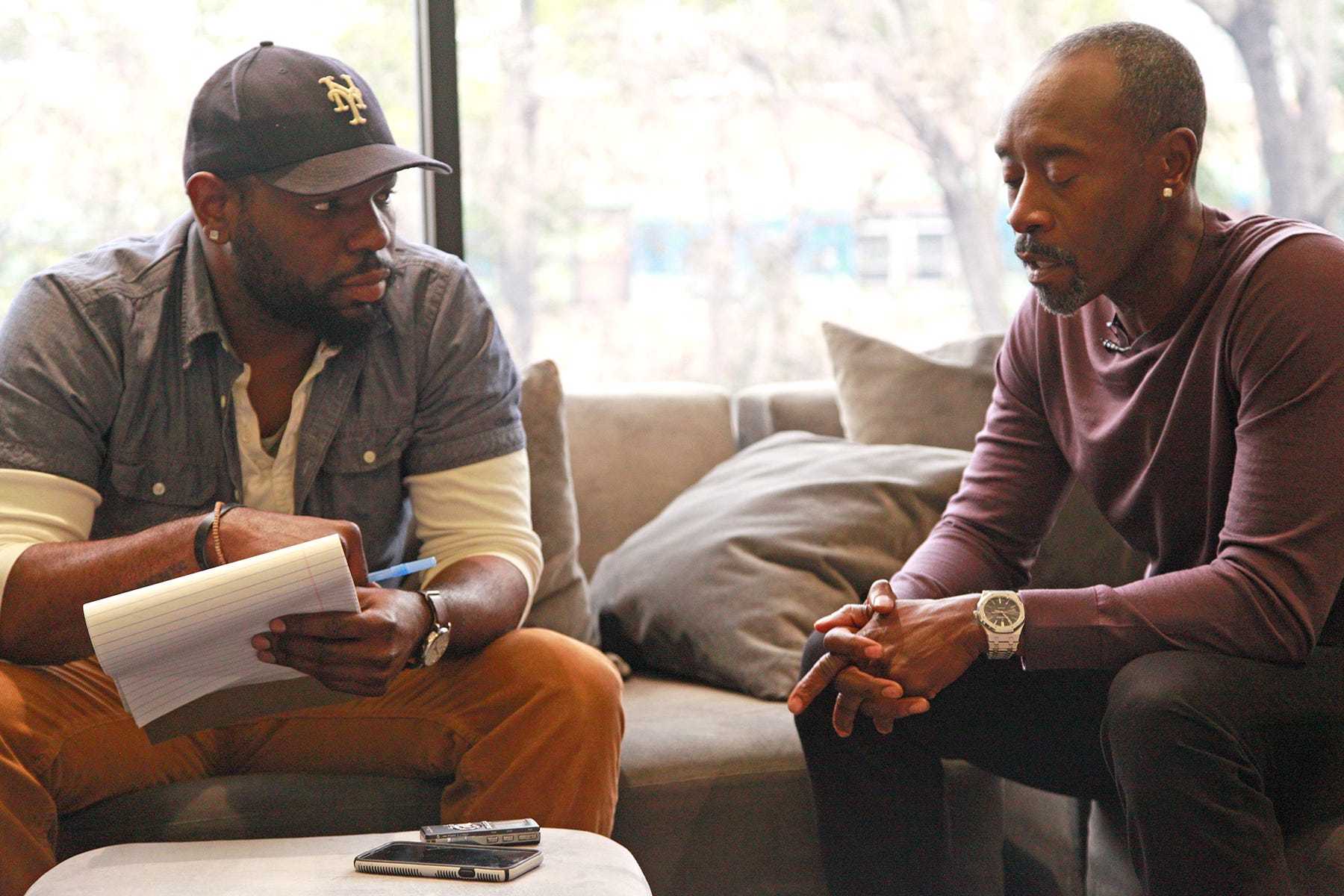
VIBE: When you get the call to do a Marvel movie, what preparation goes into it?
CHEADLE: It’s interesting because when I came in after Terrence, they called and said, “This is happening. We’d like to offer you the part. If not you, we’ll go to the next person. We’ll give you about an hour to decide” whether or not you want to be in the next…seven…movies [laughs]. I did the math and that’s 15 years, potentially. I said that I’m at my kid’s birthday party, right now. They were like, “Take two hours” [laughs]. Don’t want to jam you up, take two hours to decide your next 15 years.
And how long did it take for you to decide?
I had two hours. I literally pulled my wife to the side, and I was like, “Let’s talk this through.” And it has been something I had been saying I kind of wanted to do. But when it actually happens...I thought I would be in a Marvel movie. I didn’t know it was going to be seven. So, we had to talk about what it might be. You can’t really anticipate what all that means, and ultimately, we just said we’ll take a flier and say yes. I’m glad I did.
Ironically, you were in the movie Meteor Man, which was, at the time, the first original Black superhero to hit theatres. What was the feeling on set from Robert Townsend, who was trying to show that a Black hero film can exist in Hollywood?
All of that. He wanted to do something that he hadn’t seen, up to that point, really reflected in a way that he thought was important. And Robert really wanted to do something, too, for kids. For the youth. So that they could have that idea and have that kind of identity, as well.
Would you identify yourself as a comic head growing up?
When I was younger, I read Archie comics and Richie Rich, that kind of stuff. But, when I got to college, I started reading X-Men and Swamp Thing and Watchmen, and more serious comic books, at that point.
Were there any titles or characters that you gravitated to that you wanted to emulate?
Nah, I never felt like I wanted to be in any of them. I just really enjoyed the combination of the writing and the way they were executed. I didn’t expect the writing to be as high-minded and as dense as I felt it to be. You read [Watchmen and V for Vendetta writer] Alan Moore, and he’s raising big philosophical questions as far as power and identity and all that stuff. So I thought it was really interesting.
You mentioned that playing a superhero or being in a superhero movie is something you wanted to do.
I’ve always been an actor who’s trying to do different things and want to have a multiplicity of characters that I play. And that was something, at that point, that I had not yet done. Something was interesting on the face of it. But I wasn’t anticipating that kind of commitment. But, like I said, we’re nearing what would be the end of that contractual commitment once I started. And it’s been fun.
You sound like you’re hanging up your War Machine armor for good.
Never say never. I’m always looking to do something that I think is interesting and different than I’ve done before, and challenges me in a different way than what I’ve seen and done before.
As challenging as keeping up with fanboys’ intricate questions at Comic-Con?
It’s not a slight to call somebody a fanboy, right?
Ahem…
Fanboy
(/ˈfanboi/)
noun
1. Informal derogatory
a male fan, especially one who is obsessive about movies, comic books, or science fiction.
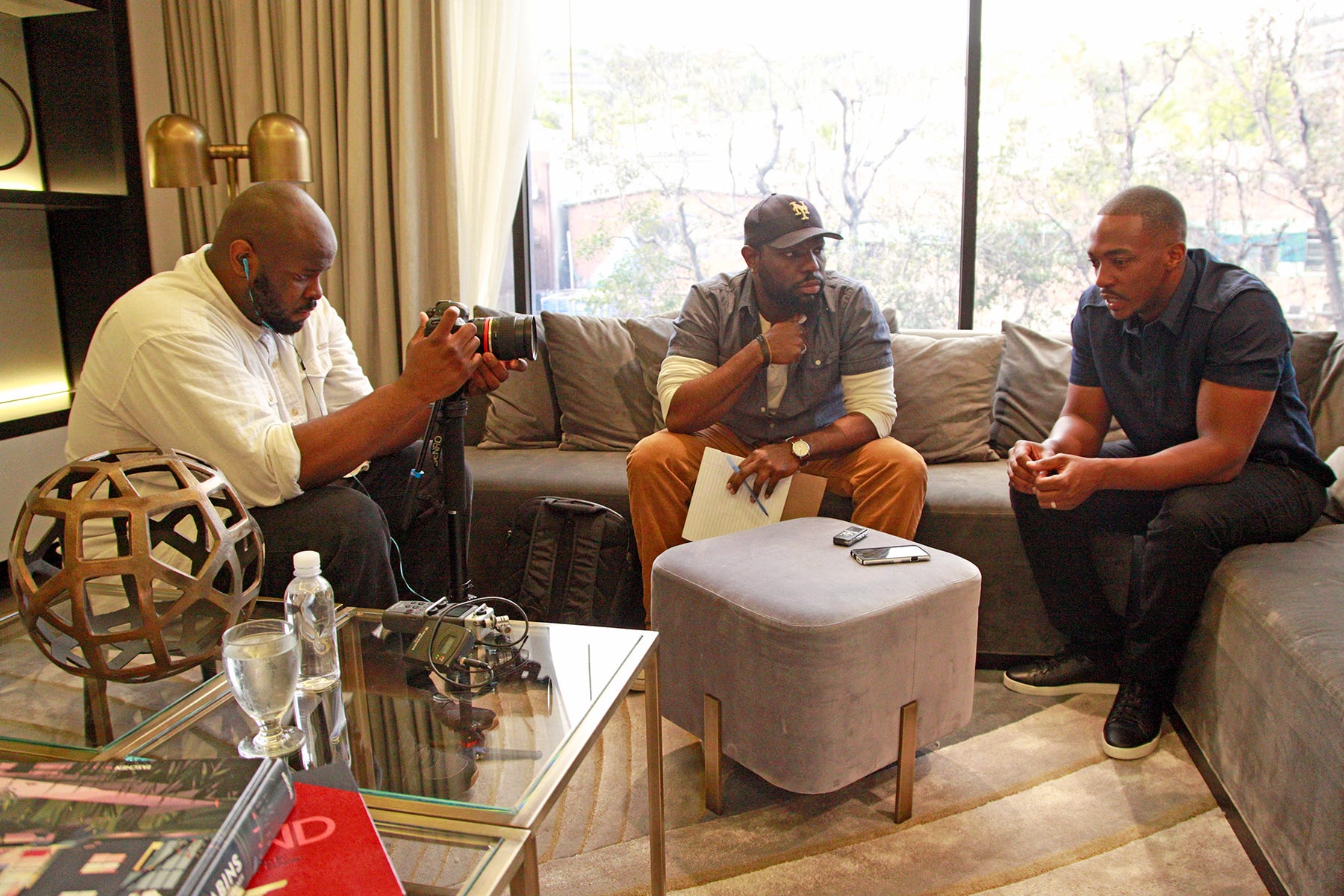
For Anthony Mackie, who has played Captain America’s right-hand man in crime fighting, Sam Wilson, a.k.a. Falcon, since Captain America: Winter Soldier in 2014, this sect of fandom has its pros and cons. “I love it when kids come up to me [and] want to take a picture,” says the 37-year-old actor. “The weird thing is the adults. They just do stuff that ain’t right. I’ve never had a chick come up to me and say, ‘Oh my God, you’re in this movie.’ Never happens. It’s always a dude who comes up to you and whispers, hot breath in your ear, ‘Yo, man…I like your movies.’ That’s why the whole fandom thing is so weird.”
All semi-joking aside—which in this interview included a hilarious demonstration on this writer of how touchy-feely some fans are toward Mackie (“Why the fuck you’re touching me in the small of my back, homie? I have a whole shoulder right here!”)—there isn’t anything not to like about the movies the New Orleans native has been in. Whether he’s busting rhymes as Papa Doc and Tupac Shakur in 2002’s 8 Mile and 2009’s Notorious, respectively, or knocking up a bevy of lesbians in Spike Lee’s 2004’s She Hate Me, or his noteworthy 2008 performance in the Academy Award-winning The Hurt Locker, or channeling Dr. Martin Luther King during the signing of the Civil Rights Act in the upcoming HBO movie, All The Way, Mackie has proven to be a consummate thespian with an abundance of range. Which makes perfect sense when you know he was Don Cheadle’s understudy for the play Topdog/Underdog in 2002. Now, 14 years later, they’re brothers in arms in one of the biggest pictures of 2016.
Kismet.
VIBE: Describe the comradery on set between yourself, Don and Chadwick while filming Civil War.
MACKIE: It’s dope, man. Ironically enough, the reason I started acting was because of Don Cheadle. One of my first jobs was understudying him, fresh out of Julliard, at The Public Theatre. I learned more, as an actor, watching him every day for two and a half months than I did at any class when I was in school. It’s fun how life kind of goes in cycles. When I got cast in this, I was excited about the opportunity of being a part of the MCU. But the reality was, I had no idea that I would be in the same sequences or scenes or had lines with the actor I admire most in this business. Because I feel like, for him, he did it the right way. If you look at his career—it’s outstanding to say he has a career—but if you look at his resume, there are not too many movies on his resume that you’d look at and say… [cringes and groans]. One of the most memorable characters in all of cinematic history is Mouse [from Devil in a Blue Dress], hands down. And he wasn’t even the lead in the movie. He messed it up for the rest of us [laughs].
Is he aware of this admiration you have for him?
Yeah, I tell him all the time. I think the idea of mentoring has been lost on you giving someone something. The ability to mentor someone is being a listening ear, being an observant friend, being someone who can tell you when you’re been slipping. And fortunately for me, Don has been there for a long time—sometimes close and sometimes far. But he is someone I’ve always judged the standard of my career on. I always say, if you have a job that you think is right for Don Cheadle and he doesn’t want to to do it, send it to me [laughs]. That’s what makes the whole MCU kind of cool, ‘cause everyone feels that way about the other actors. I’ve known Mark Ruffalo since 2003. I’ve known all these guys for so long; it’s cool to be working alongside them.
Same goes for Chadwick?
I’ve known Chad since 2002, since he was at Howard. And it’s great when you see someone who’s done it right. Chad was trained, he has an educational background, he made his way through theatre, got into film and here he is today. I don’t think we give much appreciation and admiration to people who do it the right way.
You mention “the right way” a lot. Define that.
Um, would you go to the hospital and let somebody cut on you if they never been to Med school?
Hell no.
Alright, there you go. So when you go to the hospital, you want to make sure your doctor did it the right way, right?
Right.
There you go. The problem is we have too many people entertaining us who have no history, background, understanding, or appreciation for entertainment. And that’s problematic.
And that can go from reality TV to Hollywood.
That can go from the dude making your sandwiches at Subway all the way to Hollywood.
Speaking of Hollywood, how do you feel about the emergence of Black comic characters being shown on television and in the movies, and Black actors having opportunities playing those roles?
I think it’s amazing. We’re in a position now, as a generation, where we’re demanding more. We’re demanding ourselves to be represented and we’re not just waiting on ourselves to be represented. You know, if you look at [Ryan] Coogler directing Chad in Black Panther, that’s dope. He’s going to put himself in a completely different stratosphere right now. And it’s not so much Black people. You look at the position women are in now. You look at the position that anyone in this country has now evolved to in the past 15 years; it’s really remarkable. We’re in a position right now where the two front-running Democratic presidential candidates are an old Jewish dude and a woman. That’s amazing. And the dude in the White House right now is a Black man. That’s amazing. If that doesn’t show progress and evolution, nothing does. And I think when you see it at the highest form, it trickles down into every different aspect of society.